Overview of HOKA running shoes
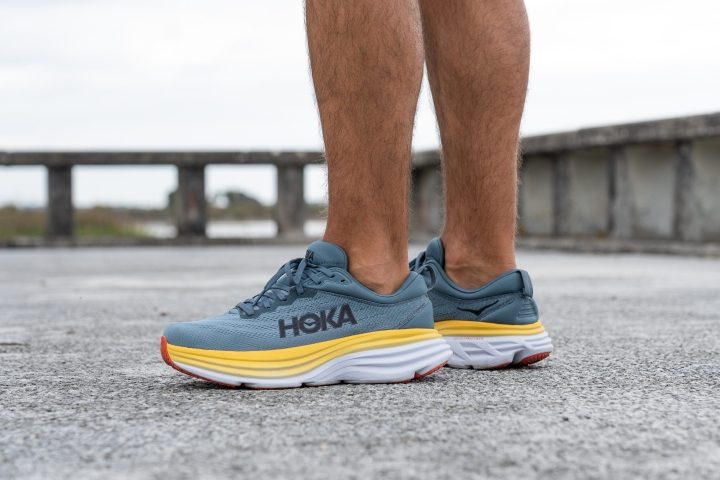
HOKA running shoes are famous for their highly cushioned and extremely comfortable design. While most HOKA shoes stay true to the brand’s maximalist roots, their product line has expanded significantly. It now includes everything from ultra plush trainers to light and responsive race day weapons.
Roads, trails, or a bit of both?
HOKA has some pretty solid options in both road and trail running shoe lines. Not to mention some excellent “road-to-trail” hybrids.
HOKA road running shoes
We recommend getting a HOKA road shoe if at least 80% of your running is done on the pavement, asphalt, tarmac, treadmill, or other hard surfaces.
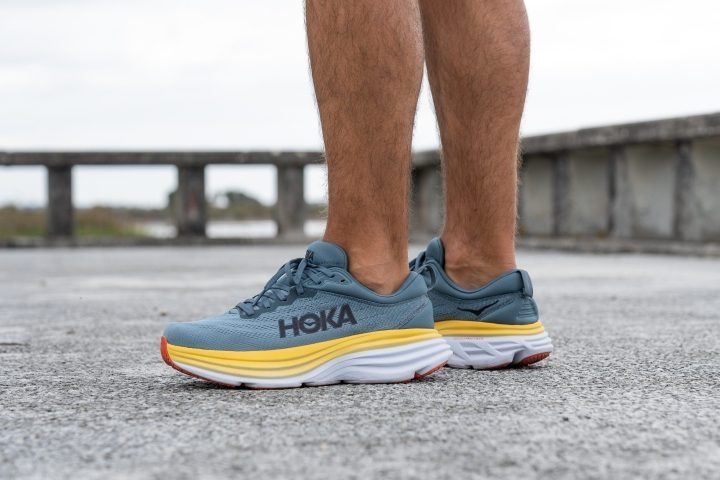
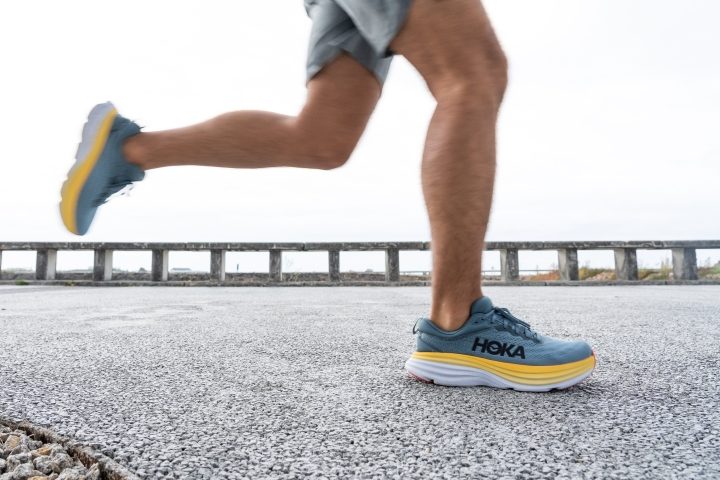
If you want to mix in some runs in the park or on light trails, consider road shoes with thicker rubber on the outsole.
HOKA trail running shoes
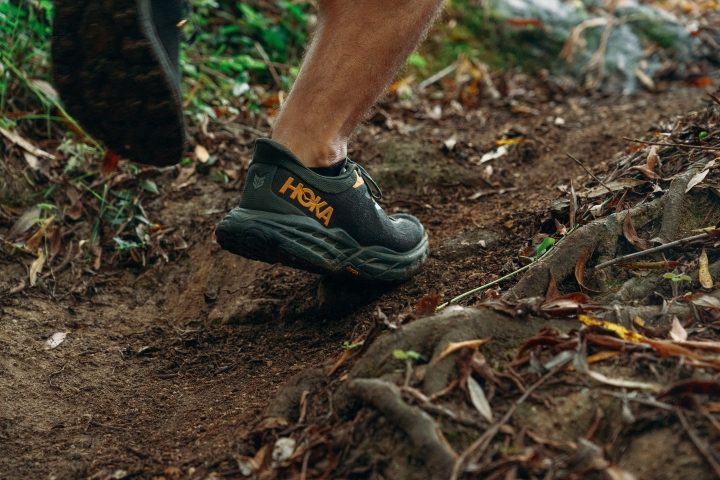
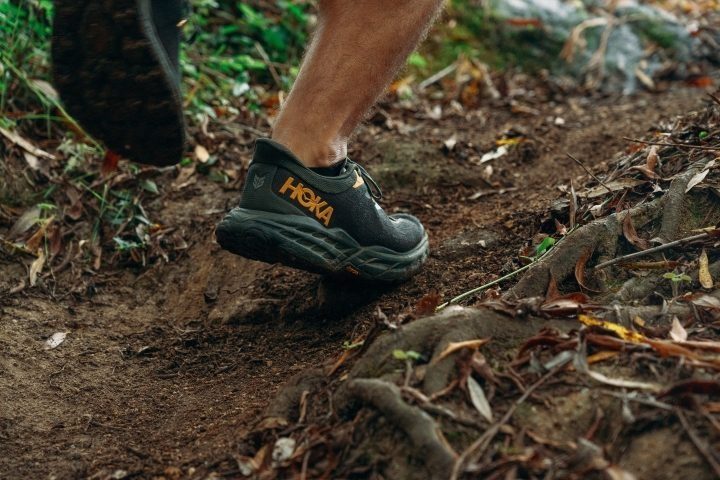
You definitely need a trail shoe if you mostly hit forest and mountain trails or run in the country.
Even though HOKA is most popular for its road shoes, the brand’s trail-ready Speedgoat series has been a best-seller for years! And the company only keeps expanding its trail shoe selection.
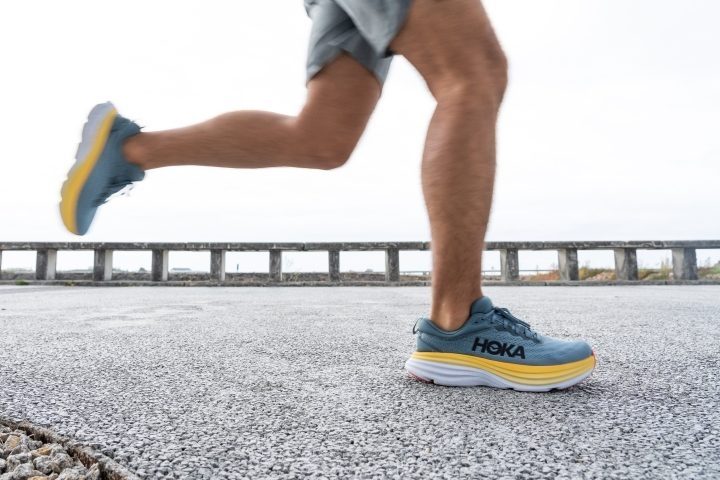
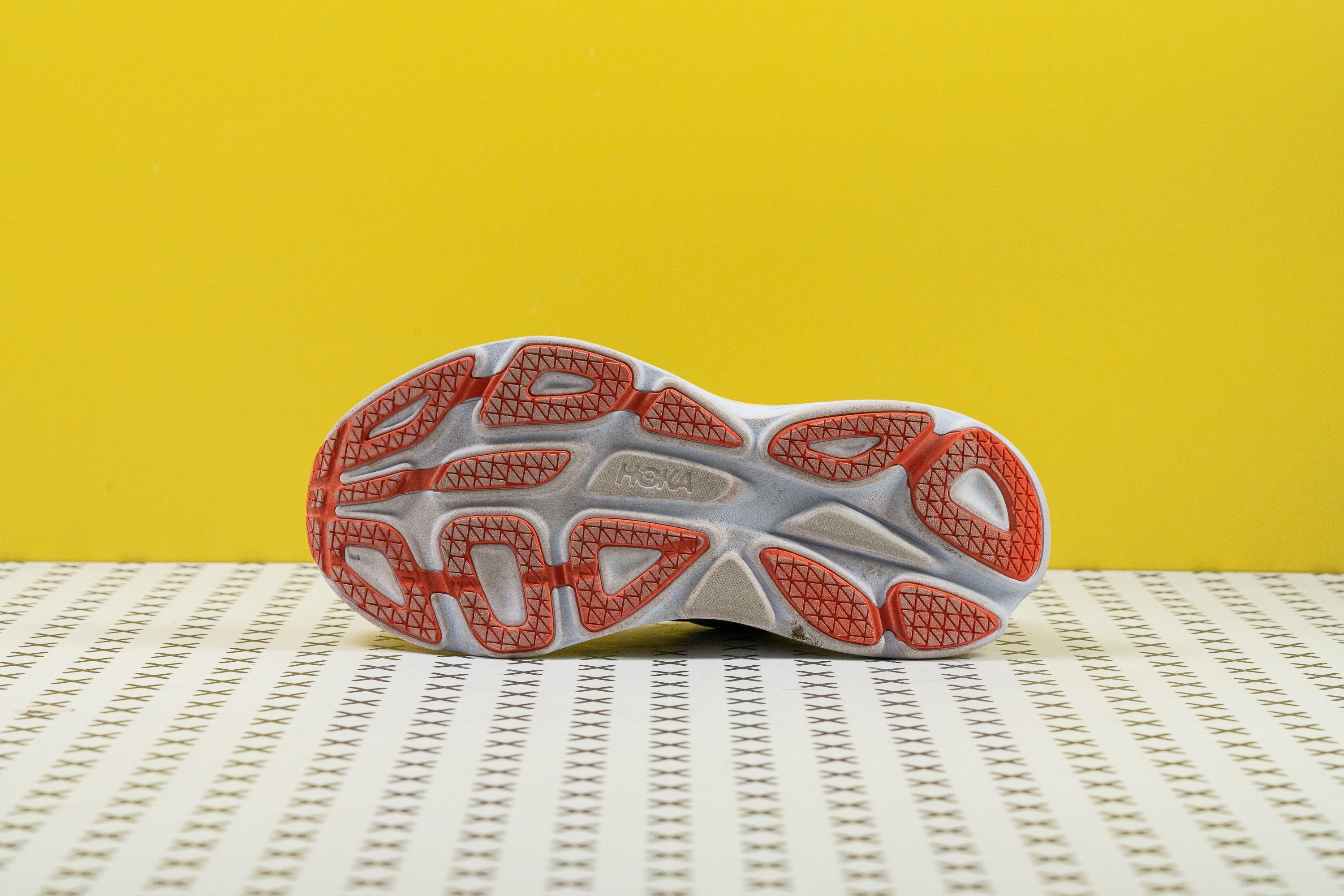
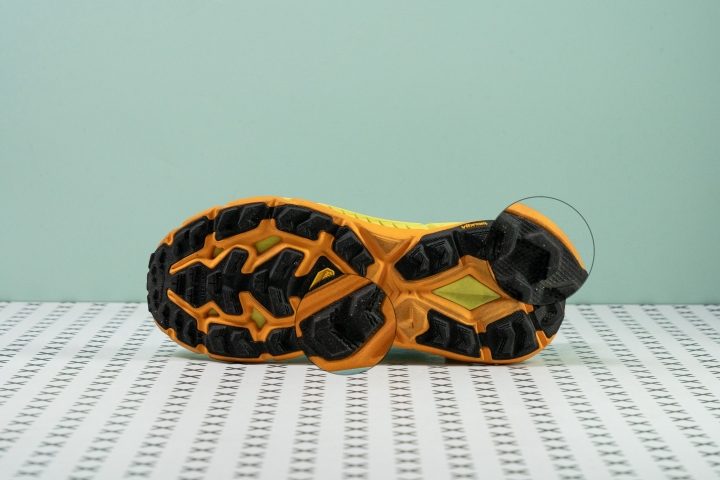
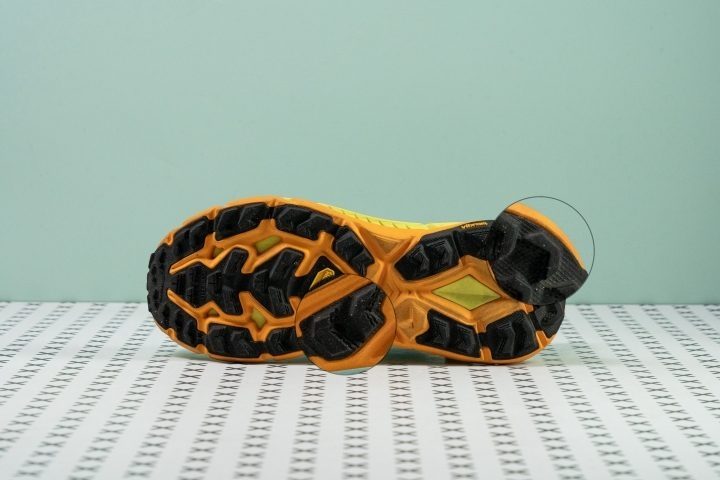
Always pay attention to lug depth and design in trail running shoes:
- Choose deeper lugs (at least 3.5 mm) for softer surfaces like grass, mud, and sand. There should also be a good amount of space in between lugs to effectively shed mud and debris.
- Choose shallower lugs (less than 3 mm) for easier, hard-packed trails made of gravel or dirt. These shoes can also be worn for short distances on the road (i.e. from door to trail).
Learn more about lugs, grip, and running shoe outsoles in our science-backed guide.
HOKA shoes for everyday runs and race days
Even though HOKA is one of the youngest brands on the market (est. 2009), it boasts a substantial selection of shoes for every type of run.
There is a spectrum, from plush everyday workhorses (Bondi and Clifton), to balanced all-round performers (Rincon and Carbon X), all the way down to responsive speedwork and race day specialists (Rocket X and Mach).
We are here to help you find the right HOKA shoe to match your athletic goals.
Daily running shoes from HOKA
If you are just starting out on your running journey, this category of HOKA shoes is right up your alley.
The brand’s huge selection of daily training shoes has enough variety to meet the needs and preferences of most runners. They also make for fantastic walking shoes with their heavenly comfort.
Here is what makes these HOKA shoes so popular and lovable:
- generously cushioned midsole (30-40 mm of heel stack, 35 mm on average)
- variety of heel-to-toe drops (from 3 to 7 mm, there is one for every type of strike pattern)
- plush yet balanced cushioning
The only drawback of daily trainers is that they compromise weight in favor of more comfort and cushioning. But luckily, HOKA found a way to keep some of its daily running shoes below the average 10 oz (283g)!
Tempo trainers from HOKA
A small bunch of everyday running shoes from HOKA is made of lighter and speedier options.
Weighing only 7-8 oz (200-225g), these trainers feel much more nimble, snappy, and responsive underfoot. They also tend to have a better energy return than daily trainers.
Consider these shoes for your tempo runs and fartleks on shorter distances up to 10K.
TIP: Lighter shoes are essential for shaving seconds off your personal best. Studies show that every 100g added to a running shoe slows you down by 1%.
Race shoes from HOKA
Competitive runners looking for their next race shoe will enjoy the latest technologies packed into these Hokas.
Here are the most prominent features that make these HOKA running shoes perfect for race days:
- lightweight (7-8 oz/200-225g)
- ultra-responsive and plush cushioning (Pebax-based foam)
- aggressively rockered shape (for fast and smooth heel-to-toe transitions)
- stiff carbon plate (for added propulsion on each step)
Did you know that thanks to carbon-plated running shoes, athletes managed to break every woman and man record on every distance since 2016? In our comprehensive research on carbon-plated shoes, we explore how this unique shoe feature helps to boost running performance.
Carbon plates in HOKA running shoes
Carbon plates help maximize energy return and propulsion on every stride. They can have a noticeable effect on performance and are now fixtures in the “super shoes” of various brands, including HOKA.
TIP: Beginner runners do NOT need carbon-plated shoes as they are most beneficial on faster paces and are more expensive.
HOKA shoes with carbon plates include the Bondi X (high-cushioned propulsive trainer), the Carbon X (all-around road racing shoe), and the Rocket X (HOKA’s premier super shoe).
HOKA even has a carbon-plated trail shoe—the Tecton X. Unlike roads, where terrain and gait stay fairly consistent, carbon plates are not always as advantageous on trails. The propulsive effect can feel destabilizing on steep descent or uneven and technical terrain. Carbon-plated trail shoes like the Tecton X are best reserved for races on buttery singletrack through rolling hills.
How to choose the right cushioning in HOKA shoes
At first glance, all HOKA shoes look the same: thick-soled, extra comfy, and brightly colored. But try dipping your foot inside each one, and you will see how different HOKA shoes can feel!
If you want to get a HOKA that works in perfect harmony with your foot and not against it, consider the following cushioning parameters:
- shock absorption
- energy return
- heel stack height (how high is the heel placed off the ground)
- heel-to-toe drop (how steep is the slope from the heel to the toes)
Shock absorption of HOKA running shoes
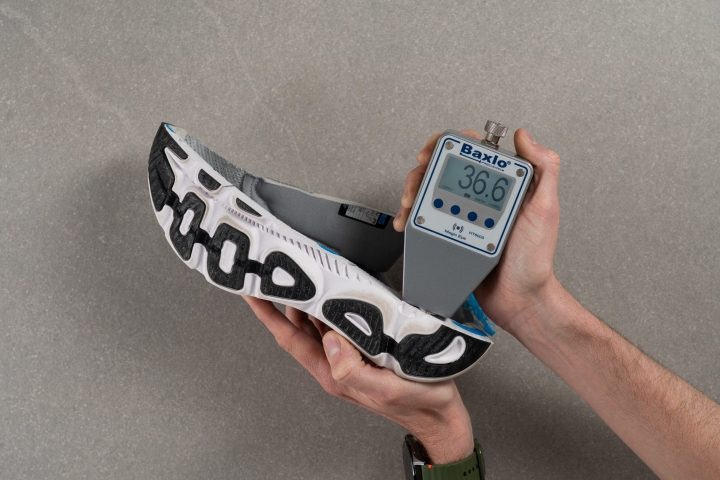
When talking about cushioning, many runners comment on the softness first. If you’re one of those runners, you may be happy to know that HOKA doesn’t have firm shoes! We found that even their firmest models are only in the “balanced” category.
So, if softness is what you prioritize, look for lower numbers. If you prefer a firmer ride, look for a higher durometer reading. However, we think the spotlight should not be directed only at softness. Shock absorption is a very important feature because it actually tells us how protective the midsole is!
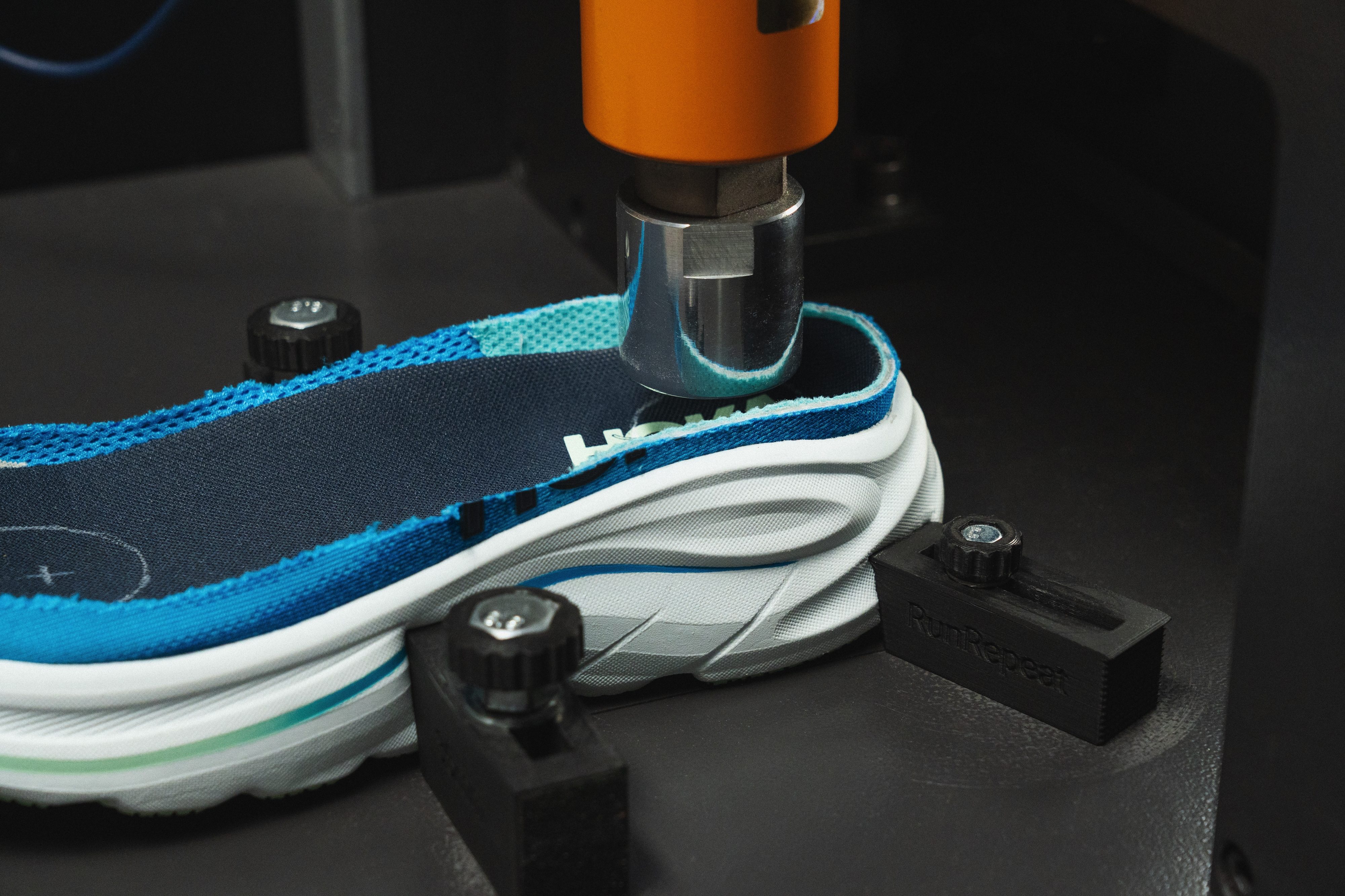
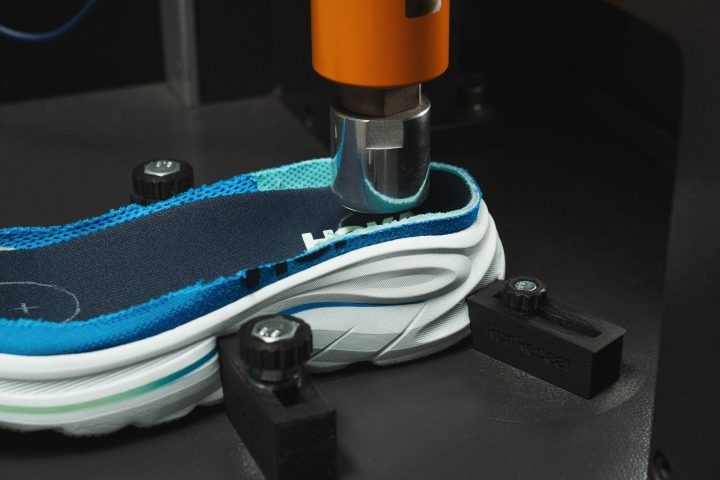
Measuring the shock absorption and energy return in RunRepeat lab
To test and quantify shock absorption, we honor the ASTM F1976 13 methodology. We drop an 8.5kg mass from a height of 50 mm, with a total energy input of 5 J. We perform this test both at the heel and at the forefoot. This way, you can look for good shock absorption exactly where you need it (where you land, depending on your foot strike).
Energy return of HOKA running shoes
While the foam can dampen the impact, that measurement (shock absorption) does not tell us how bouncy the foam is. And having shoes with a good energy return is a priority because dull foams cause premature fatigue which we definitely want to avoid.
If you don’t feel comfortable with these terms, we wholeheartedly recommend reading our in-depth guides: Energy return in running shoes explained and Shock absorption in running shoes: Explained and tested.
Usually, race-day shoes have record-high energy return. It’s not unseen for a daily trainer to score high as well!
Heel stack heights in HOKA shoes
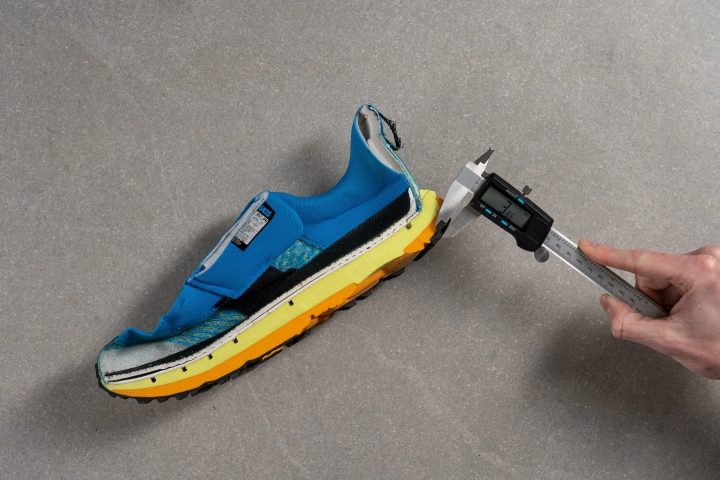
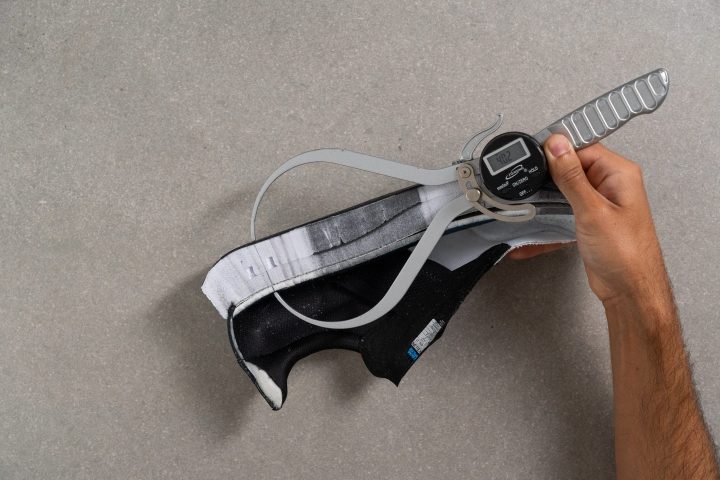
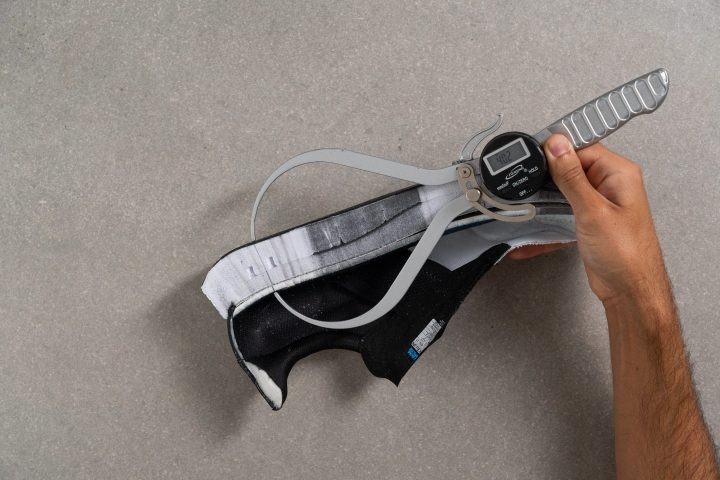
We don’t even need a caliper to prove that HOKA shoes have some of the tallest stack heights among running shoes.
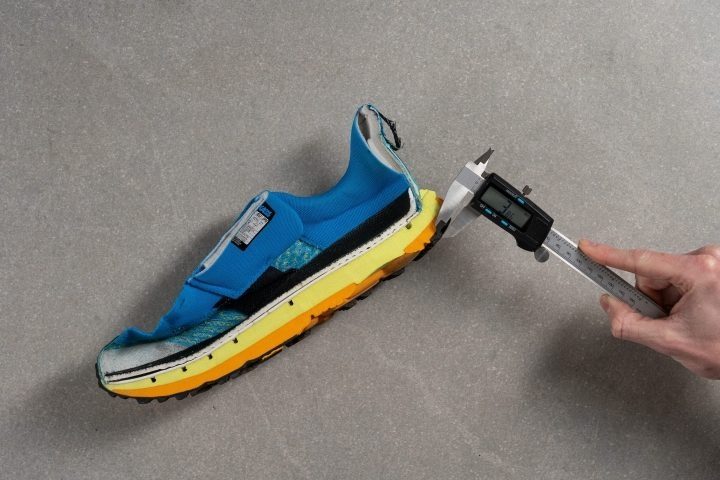
We even came across a potentially “illegal” HOKA shoe! With a heel stack of 40.2 mm, the Transport X exceeds the allowed 40 mm which means that it could be disqualified from a competition!
Based on our lab measurements, the heel stack in HOKA shoes ranges from 30 to 40 mm, averaging 35 mm. This is a few millimeters thicker than running shoes on average.
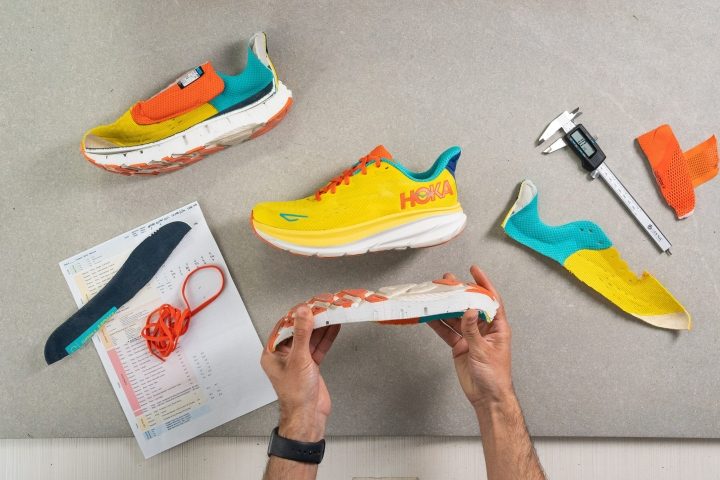
But thicker doesn’t necessarily mean better. Especially for beginner runners.
To avoid straining your feet and tendons, we recommend HOKA shoes with a moderate heel stack of 30-35 mm.
A heel height beyond 35 mm is typically seen on HOKA shoes that are best for:
- slow recovery runs
- marathon and ultra distances
- elite race shoes
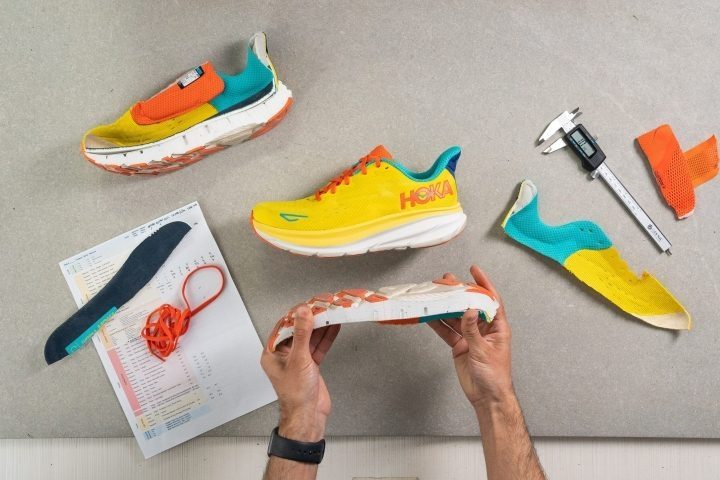
Heel-to-toe drop: a quick guide
The drop makes such a big difference that HOKA even added a filter for it on their official website.
Referring to the difference in height between the heel and forefoot stacks, the drop can make or break your running experience.
As a beginner runner, you will most likely feel comfortable with a higher drop (at least 8 mm) because:
- it accommodates a heel-striking pattern (when your heel lands first followed by the midfoot and forefoot)
- it takes some load off the Achilles
On the other hand, seasoned runners are more likely to go for the lower drop (less than 8 mm) because:
- it accommodates their midfoot/forefoot striking pattern
- it has the potential to improve cadence
If you have further questions about the drop and how it affects performance, check out our extensive research on the topic.
Arch support in HOKA running shoes
You are likely to need a pair of stability shoes from HOKA if you experience the following:
- you have flat/fallen arches
- your feet tilt inwards a lot (overpronate)
- your shoes wear out more on the inner side
If you are not sure, consult a podiatrist or have a look at our detailed guides on pronation and arch support.
Example of a stability HOKA shoe with arch support
Example of a neutral HOKA shoe without arch support
There are two long-standing stability shoe series from HOKA: the Gaviota and the Arahi.
HOKA Gaviota A max-cushioned mile eater, the Gaviota spares nothing when it comes to stability and cushioning. It is a super comfy daily trainer for overpronators, suitable for short recovery runs and very long training sessions. HOKA Arahi The Arahi is lighter and nimbler than the Gaviota but shares its chunky aesthetic. Despite its looks, this stability shoe is surprisingly responsive and fun to run in.
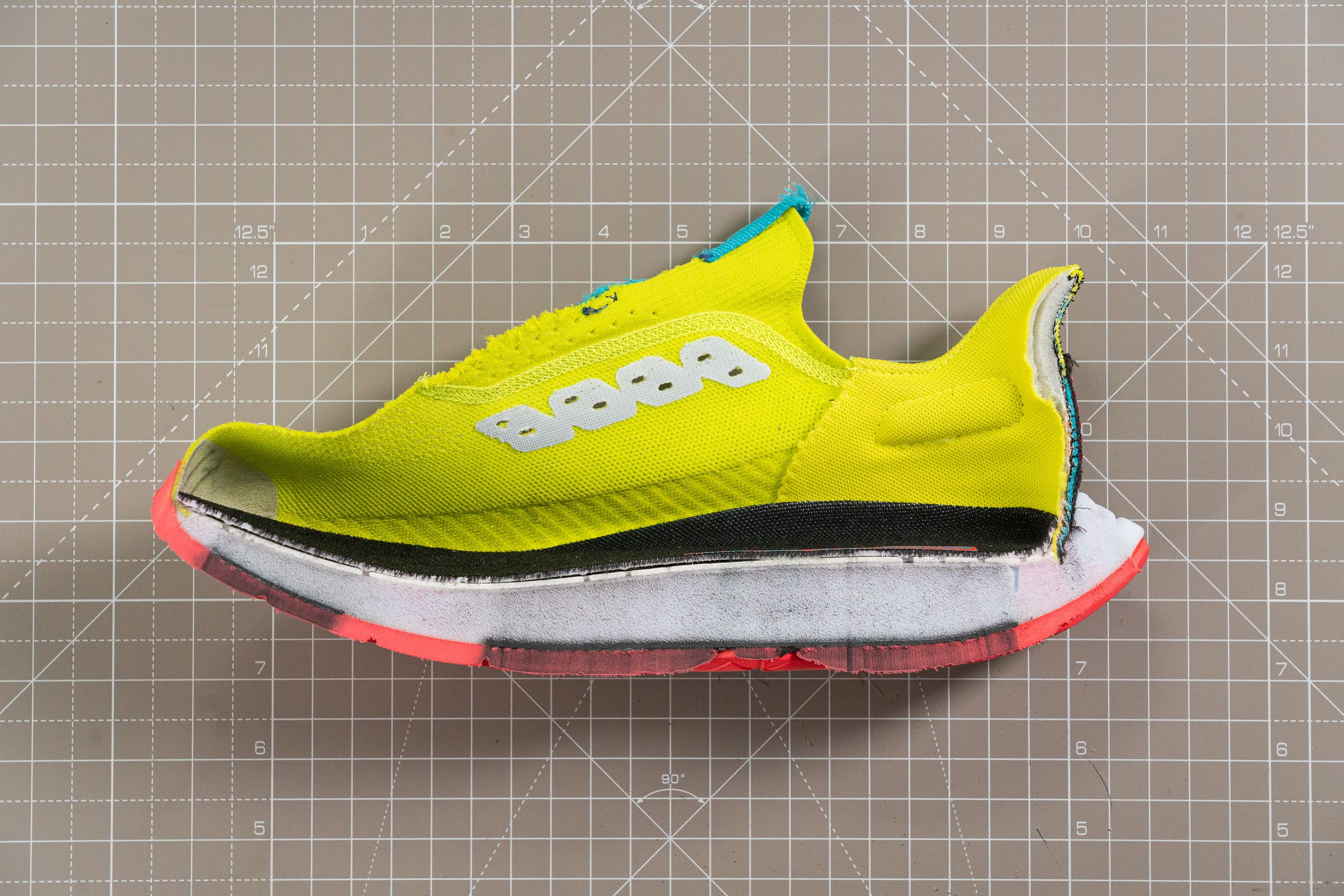
To assess the amount of stability and arch support in a shoe, we perform the following tests:
- Torsional rigidity: manual twist-and-bend test, rated on a 1-5 scale where 5 is the stiffest.
Shoes with high torsional rigidity create a steady platform and don’t let the foot roll over the edge of the shoe.
- Heel counter stiffness: manual push-and-squeeze test, rated on a 1-5 scale where 5 is the stiffest
Shoes with stiffer heel counters have a better heel and ankle hold. They don’t let the rearfoot slide inwards and prevent heel slippage.
- Midsole width: measured with a caliper in both the widest part of the forefoot and the heel
Shoes with extended contact points create an extra stable base to prevent the foot from rolling over.
Get the right size and fit in HOKA shoes
In general, HOKA shoe sizing tends to be consistent with other major brands like ASICS, New Balance, and Brooks. But if you’re ordering shoes online, you want to be extra confident to avoid returns.
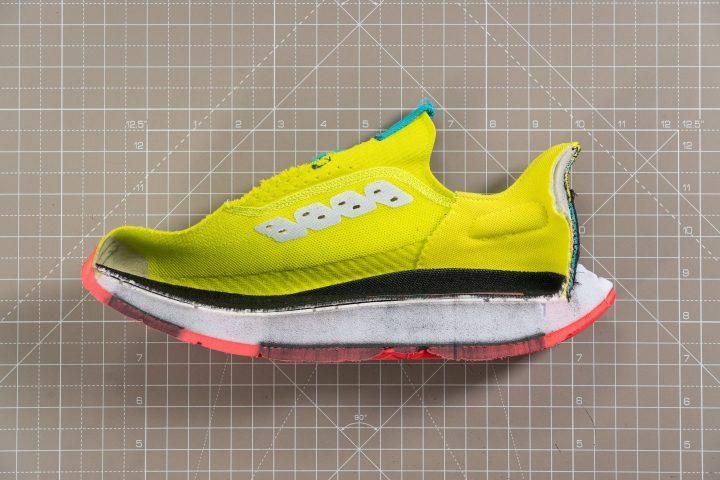
First of all, we highly recommend measuring your foot length precisely. You might be surprised to find out that your feet keep growing! Then, check your corresponding HOKA size in the brand’s official size chart.
In addition to getting the right size or length, you need to ensure that the HOKA shoe you choose has enough toebox width for your feet.
To get accurate measurements of the fit, we make a gel mold because it reflects the interior volume of the shoe perfectly
When the gel mold is ready, we start measuring: a) the width of the shoe where it’s the widest, b) the width of the toebox at the big toe, and c) the height of the toebox.
Based on our lab measurements, HOKA shoes don’t have particularly wide toeboxes, but they do fit as expected for a medium width.
If you prefer HOKA shoes with a pointy toebox, look for those that are narrower at the big toe. If you need more room in that area, look for the widest HOKA toeboxes at the big toe.
If you’re afraid of HOKA running shoes pressing on your toenails too hard, look for those with the highest toeboxes!
On the bright side, the brand offers some of its running shoes in wide and extra-wide options.
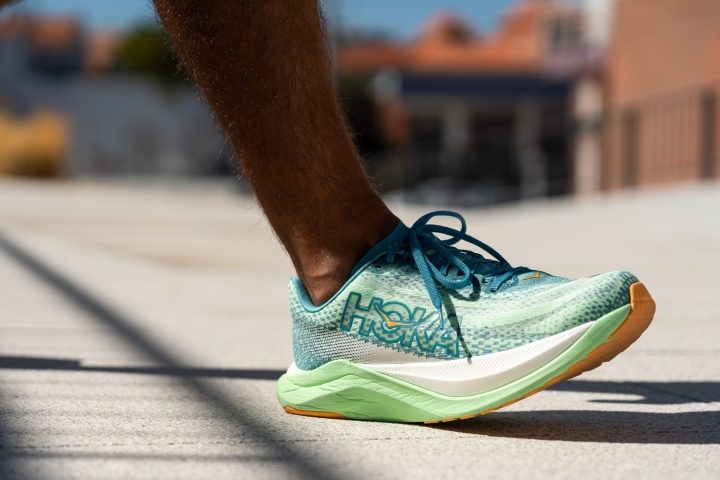
In addition to measuring each HOKA shoe’s toebox dimensions, we also check how thick is the tongue and whether it’s gusseted or not. These parameters also have an effect on the overall fit and feel of the shoe.
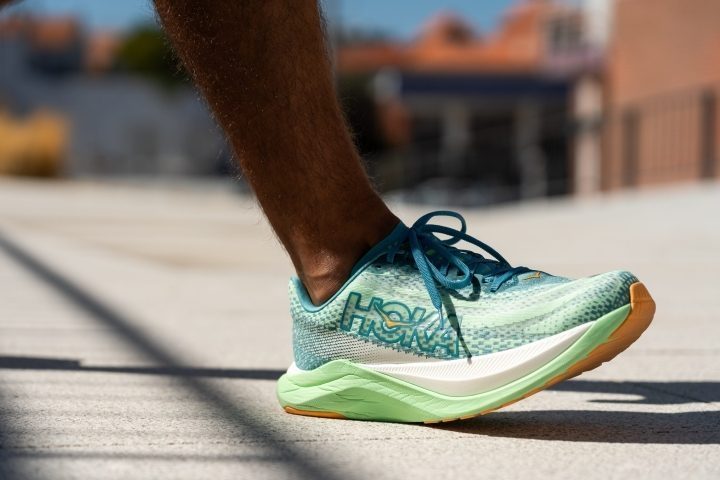
We also take a closer look at the upper material and how padded and stretchy it is on a given HOKA shoe.
Rain or shine: HOKA has shoes for both
Knowing how much breathability can affect your running experience, we take it just as seriously as the shoe’s cushioning.
Each HOKA shoe is thoroughly scrutinized in our smoke-pumping machine test where we rate the amount and speed of smoke passion through its upper material.
The smoke test is followed by a transparency check and a microscope inspection which reveal the shoe’s most ventilated areas.
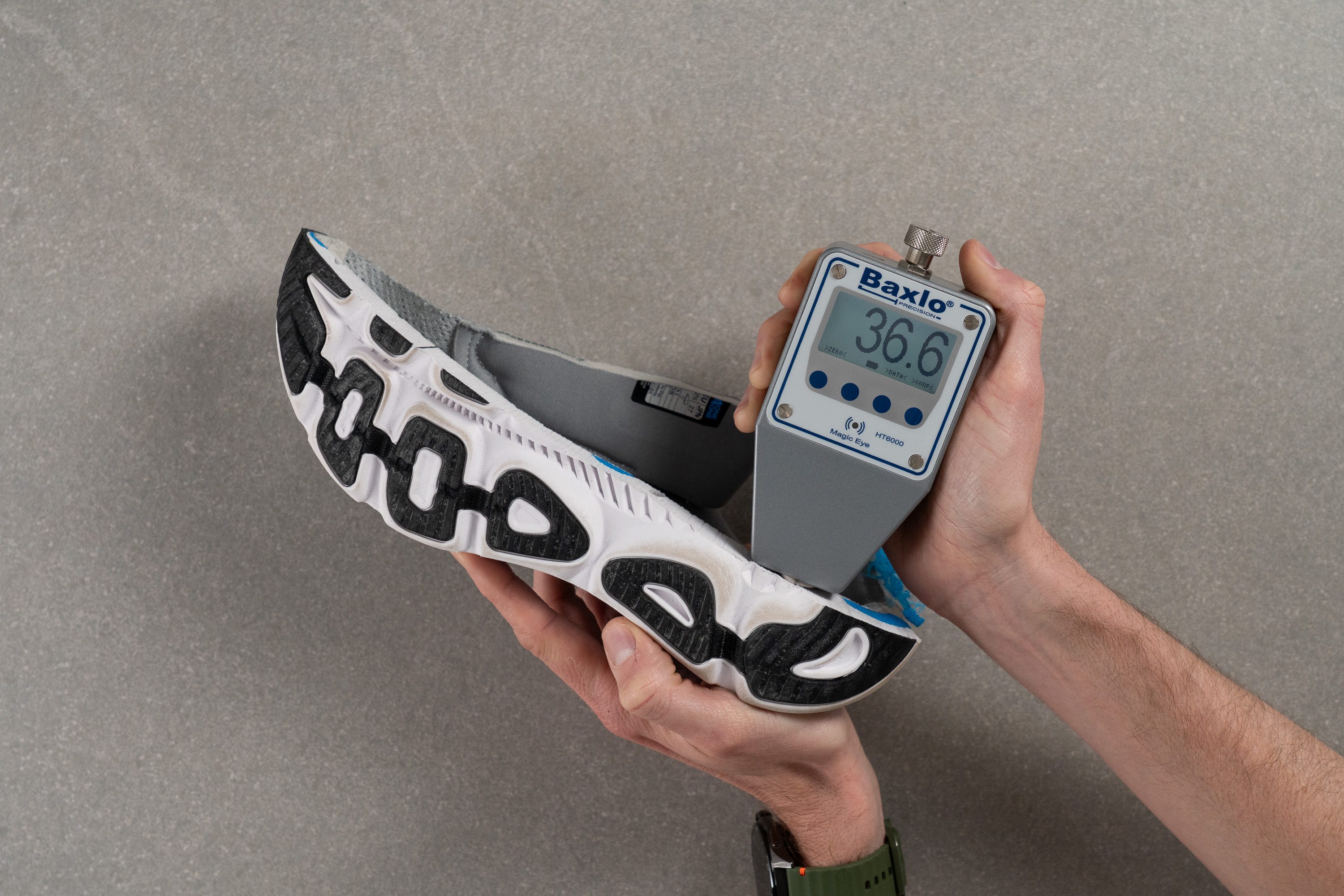
You sure want the most breathable HOKA shoes for a hot summer day. We have filtered out the airiest ones in the table below:
On the other hand, if you are braving the cold season, you may want a warmer HOKA with a thicker upper to keep you cozy:
Some HOKA shoes are endowed with a waterproof GTX (Gore-Tex) membrane. This world-class technology has outstanding waterproofing capacity without suffocating the feet.
You will need this feature if you frequently run in rain, puddles, snow, slush, and other wet conditions.
The best technologies in HOKA running shoes
All HOKA running shoes feature three core technologies, each finely tuned to offer different levels of speed, stability, and support.
Lightweight cushioning foams
Thick, highly cushioned midsoles are what most people think of first when they think of HOKA shoes.
The brand’s most recent cushioning offerings can be split into two categories:
Standard Premium
used in daily runners and tempo shoes
used in race-ready shoes
ProFly (EVA) ProFly+ (EVA) unnamed PEBA-based
- bouncy
- durable
- comfortable
- snappy
- more bouncy
- softer
- exceptionally bouncy
- neither too soft nor firm (in between Nike ZoomX and ASICS FF Turbo)
used in Mach 4 used in Mach 5
first introduced in the brand’s debut super shoe, the Rocket X 2
Meta-Rocker design
HOKA soles are engineered with a curved Meta-Rocker design to encourage quick and efficient heel-to-toe transition. The rounded soles and a relatively low drop (most HOKA’s have a 4 mm to 5 mm drop) create a snappy stride and prevent that “flat” feeling you get in some running shoes.
We have put together everything a runner needs to know about rockered running shoes in this research.
Performance-oriented HOKA running shoes have an “Early Stage” Meta-Rocker, with the rocker point located under the balls of the feet to promote fast transitions. To put it simply, the toe tip is lifted higher up in these shoes.
HOKA’s stability trainers, walking shoes, some trail shoes, and hiking footwear all use the “Late Stage” Meta-Rocker, with the rocker point placed closer to the toebox for added stability.
Active foot frame (J-Frame) for arch support
Some HOKA running shoes all have a deep, molded foot frame that cradles the foot comfortably. Embedding the foot frame deeper into the midsole adds to the security of Hokas and helps the shoes feel stable, even with their characteristic ultra-high stack heights.
FAQs
Do HOKA shoes prevent injuries?
The thick midsole cushioning in HOKA shoes aims to provide excellent shock absorption and reduce impact on joints. High-cushion shoes may potentially lower the risk of certain injuries, but the scientific evidence is not as conclusive as shoe brands would like you to believe.
Individual biomechanics, running form, and smart training play bigger roles in injury prevention than any particular shoe.
Why are HOKA shoes so expensive?
Based on our database, the average price of HOKA running shoes is $160 which is $20 more than running shoes across all brands on average.
We believe that Hokas are generally priced on the higher end for a few reasons:
- The brand invests heavily in research and development to create innovative designs and technologies, which contributes to higher production costs.
- They also prioritize quality materials like high-grade cushioning foams—and their shoes include a lot of cushioning.
- Finally, HOKA shoes have exploded in popularity over the last decade, contributing to their premium price tags.
Are HOKA shoes durable?
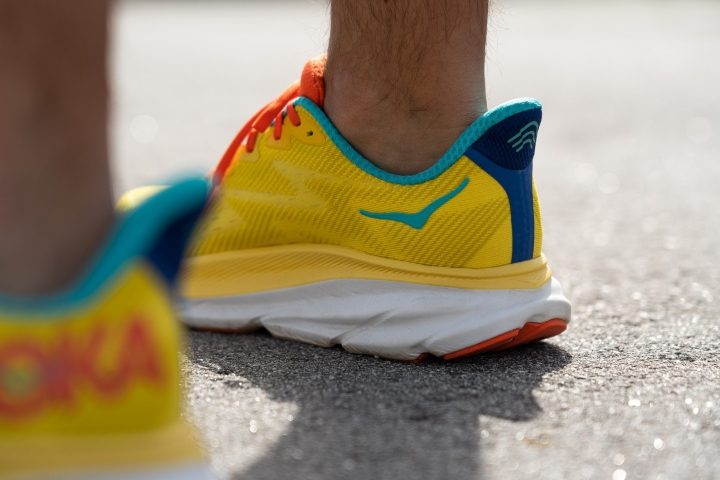
HOKA shoes are generally reputed for their solid durability. The brand utilizes high-quality materials and construction techniques.
HOKA’s proprietary EVA midsoles hold up well over hundreds of miles. The outsoles of HOKA shoes feature durable rubber compounds and their trail shoes have Vibram lugs: the industry standard for both performance and durability.
In our lab, we put each HOKA shoe through a series of demanding tests to give you a better idea of which shoes excel in durability.
A Dremel durability test performed on the HOKA Solimar
Here is the overview of the most durable road and trail running shoes from HOKA:
*Toebox and Heel padding durability are evaluated on a 1-5 scale where 5 is the most durable. As for the outsole, its durability is measured by the depth of the dent caused by the Dremel – the lower the number, the more durable.