Despite the fact that Crocs were medically recommended for my personal circumstances, they aren’t necessarily the best footwear choice for every person, injury, or occasion (style or otherwise). You should speak to your doctor before investing in Crocs and changing your footwear routine, especially if you’re dealing with any kind of foot injury.
To better understand what exactly about my situation necessitated Crocs, I interviewed my own podiatrist, Robert Fridman, DPM. (Fridman has no financial relationship with Crocs, but I must disclose that he does have a financial relationship with me, in that I have paid him for treatment.) He — a runner himself — has worked closely with athletes and runners to diagnose and treat chronic pathologies like my own.
“Every tendon in the body has to have an opposite, there is a push-pull,” Fridman tells me. “The antagonist of the plantar fascia is the Achilles tendon, which attaches to three muscles in your calf.”
Imagine your legs dangling off the edge of a dock or a kitchen stool. Neither the Achilles nor the calf muscle is working, so your feet are just hanging mid-air. Fridman explained that when the foot is hanging unimpeded like that, the toes drop, the heel lifts, and the foot naturally finds itself at a differential of about an inch between the heel and the toes.
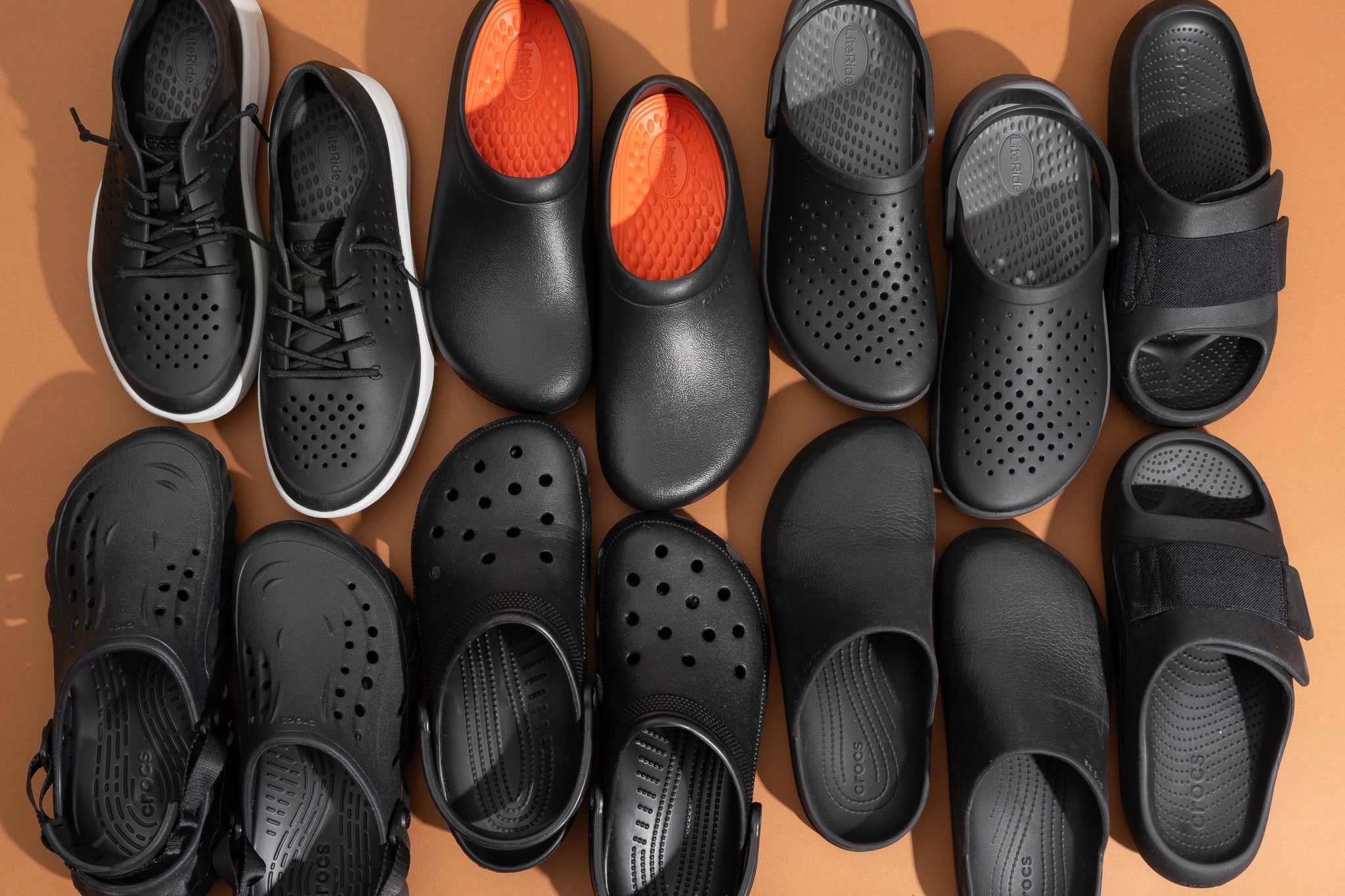
That differential, Fridman said, happens to be almost exactly the heel-to-toe drop of Crocs. According to Fridman, a shoe that can hold your feet in this position (with a little cushion beneath it) can help a foot recover from high-impact activities like running or even long days of walking.
Walking around barefoot on hard floors and wearing thin-soled shoes on pavement can be tough on feet, and the plush soles on a pair of Crocs can help provide a softer landing.
That being said, Fridman stressed that even in cases like mine, Crocs aren’t meant to be worn all the time, or for extended walks. They’re great for around the house, idle times, and for short trips to the grocery store, but not for a day of trekking across New York. Crocs can often be very loose on the foot, and in order to keep one’s foot securely in them, Fridman said that wearers instinctively begin to make countless micro-adjustments using small muscles — an unnatural overreliance that can further exacerbate foot pain.
More importantly, Crocs are not a cure-all, and in cases like mine, they’re merely a single piece in a multifaceted approach to treating foot and ankle pathologies. If you find yourself relying on something like Crocs to tolerate even minimal walking, a larger issue might be contributing to your pain.
“If you have an inability to be comfortable and safe without a very specific piece of footwear, that would be a case where I would probably consult a medical professional, and we would say, all right, what’s going on with this individual?” Ryan Chapman, director of the biomechanics and wearables lab at the University of Rhode Island, said in a video call. So if this is your situation, you may want to speak with your doctor before relying on Crocs for pain management.
I am not unique in my journey through foot pain: Fridman mentioned that he saw a notable uptick in cases of plantar fasciitis following the first pandemic lockdowns, likely stemming from more people working from home and walking around barefoot on hard surfaces for far longer than they previously ever had.
Armed with the science, the message was clear: To reduce pain and return to running, I had to wear Crocs.