
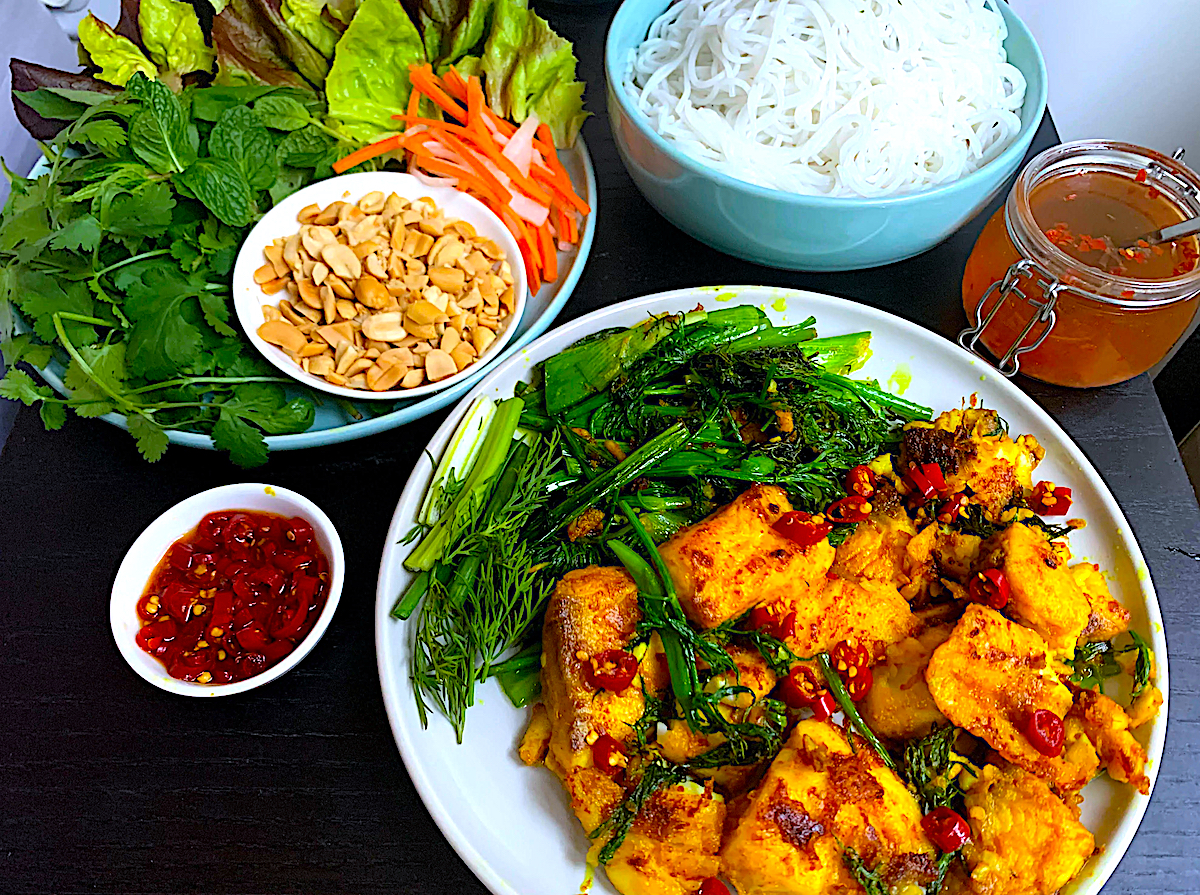
My glorious Citizens – today is part II of Operation ‘Fish-supper’, an attempt by the Potentate of the Piscine to actually live up to this exalted title and share the nemesis of My Pax Gastronomica – recipes for freshwater fish. Yes, I am forced to admit there are a serious dearth of freshwater fish recipes here on TFD – for the simple reason that I am just not fond of the taste of most freshwater fish, but I *AM* fond of Asian fish recipes from sweet water, and here is the second of them!
This particular recipe hails from Northern Vietnam and is a symphony of herbal, spicy and sweet flavors – this particular dish masks the smell and taste of the catfish meat quite effectively, making it a GREAT recipe for children or those with finicky palates (get it?) like me. The dish is a hallmark of Hanoi-style cooking and is truly a special recipe that I am delighted to share with TFD Nation at this very moment! It’s rarely seen outside Vietnam or the most authentic Viet restaurants – a true pity.
Cha ca La Vong (Chả cá Lã Vọng in Vietnamese) is a Vietnamese grilled fish dish, originally from Hanoi. The dish is traditionally made with hemibagrus (or ca lang in Vietnamese), which is a genus of catfish. The fish is cut into pieces and marinated in a turmeric-based sauce, which often includes shrimp paste or fish sauce, ginger, and chili peppers. Sometimes, saffron is used instead of turmeric. It is then lightly grilled over charcoal.
The dish is served in a hot pan coated with marinade sauce and herbs, particularly dill. Other herbs, such as scallions or basil, may be included. It is eaten with vermicelli rice noodles (bún in Vietnamese) and peanuts. Cha Ca La Vong is considered a delicacy in Vietnam, as it is nearly exclusively served in restaurants and is not found in street food.
In the 19th century, the Doan family were known to prepare grilled fish for their neighbors. The dish became so popular that their local community helped the family open a restaurant named Cha Ca La Vong, in 1871. The words ‘Cha ca’ translate to ‘grilled fish’ in Vietnamese. ‘La Vong’ was inspired by a local statue of Jiang Ziya, also known as Lu Wang (pronounced as La Vong in Vietnamese), the fisherman-turned-politician who symbolized the potential for patient, talented people.
The restaurant opened at 14 Hang Son Street, between Hang Ma and Lan Ong streets, in the Old Quarter of Hanoi. This was reportedly the same street where the Doan family had lived before opening the restaurant. It was managed by Doan Phuc and his wife Bi Van. In its early days, the restaurant was a meeting place and hideout for anti-colonial rebels. However, the restaurant later became popular with aristocrats and colonial troops of French Indochina.
Copycat restaurants opened on the street with similar names, such as Cha Ca La Song, while other restaurants used the exact same name. For this reason, Hang Son was officially renamed Cha Ca. The original Cha Ca La Vong restaurant is still open in Hanoi, where it only serves its signature dish, and guests eat from charcoal burners at communal tables. The restaurant was listed as a destination in the book 1000 Places to Visit Before You Die – that’s how good this dish actually is!
The dish has left a strong impression on food critics and bloggers. As explained by Florence Fabricant, “The combination of ingredients — turmeric, dill, shrimp paste and fish sauce — delivers an intriguing muskiness bolstered with chiles, silky noodles and a thicket of other fresh herbs to season the chunks of moist fish. My memories are still vivid after 10 years.”
Some chefs have developed their own interpretation of the dish, particularly in places where hemibragus may be less common. In the United States, some restaurants serve the dish with a variety of fish types and cooking styles, including: grilled catfish satay, grilled basa, grilled tilapia, whole broiled flounder, and halibut salad. TFD – of course – only calls for using farmed catfish here in the United States, which is a mild and sweet critter without the muddy flavor of wild catfish that I despise.
I am particularly intrigued by this especial recipe because of its use of turmeric – a spice most closely associated with India and other southeast Asian countries, but not with Vietnam. I am making an educated guess that this dish was strongly influenced by Indian traders in Hanoi, or a Chef who had access to Indian spices, as I cannot find another instance of a mainstream Viet dish using fresh (or dried, for that matter!) turmeric as a main ingredient!
The use of dill and several other fresh herbs *IS* quite classically Vietnamese, of course – and the dipping sauce is the classic Mắm Tôm, using shrimp paste, lime juice, chilis…and one VERY unusual and equally rare ingredient – I speak of nothing less than Mangdana liquid, which is extracted from the thorax of the giant water bug (called cà cuống in Vietnamese). It is used in very sparing quantities to add a unique flavor to dipping sauces, broths and noodle dishes.
As noted on heraldweekly.com:
When you’re roaming the streets of Hanoi, you might come across a select number of food kiosks selling ‘cà cuống essence’, a much sought-after condiment. This costly extract is made from a water bug (Lethocerus indicus), which is becoming increasingly rare these days. With its piquant aroma, cà cuống is the perfect accompaniment when you’re munching steamed rice rolls.
Although the condiment is popularly known as a water bug “essence,” it is actually pheromone, a chemical substance emitted by male bugs to attract females during mating season. During the labor-intensive extraction process, the pheromone is obtained by hand from a small, liquid-filled sac in the water beetle’s body. Producing 25 milliliters of its essence requires more than 2,000 of these insects.
The flavoring agent — described as having a funky yet floral aroma — that comes from this process is then added to various Northern Vietnamese broths and soups. Because of the exorbitant price tag of the authentic version of this essence, most households just use the synthetic variant. For the purists (and those with plenty of cash to spare), however, only the genuine article will do, which is reputed to be a robust aphrodisiac.
But here’s a word to the wise: according to some, eating too much of this condiment can make your mouth go numb, so you might want to exercise some caution before reaching out for more.
Some contend that the best use for cà cuống is to add it as a flavor enhancer to the dipping sauce for ‘bánh cuốn’, or steamed rice rolls, which are a popular street food in Hanoi. It is also a great choice as a potent flavor add-on for ‘chả cá lã vọng’, a sautéed dish that mixes fish with dill, lots of onions, and other herbs.
Gastroobscura.com has this to add on the subject:
On the streets of Hanoi, a select few food stalls offer a coveted condiment: cà cuống essence. The expensive extract comes from an increasingly rare water bug (Lethocerus indicus) whose pungent aroma will make a snack of steamed rice rolls an unforgettable experience.
Although it is billed as water bug “essence,” it is in fact the pheromone that the male bug uses to attract the female during mating season. The pheromone gets extracted from a tiny, liquid-filled sac in the insect’s back by hand in a laborious process. More than 2,000 male water bugs are needed to produce 25 milliliters of the essence.
The resulting flavoring agent, which has a funky yet floral aroma, is added to a variety of Northern Vietnamese soups and broths. Bear in mind, though, that the real deal is pricey, so a synthetic version is the commonly-used household favorite. Traditionalists, however, still prefer splurging on the actual water bug essence, which is said to be a strong aphrodisiac.
This video goes into more depth!
Cà cuống is almost impossible to find in this country – especially the real deal version! The synthetic variant may be purchased from here, or you can instead substitute a single drop of natural (not synthetic, in this case!) Pandan essence, which is somewhat closely related in smell and is a lot easier to find (buy a good, REAL version here).
The marinade for the fish is both flavorful and complex and is ever so slightly sour due to mẻ, a fermented rice mixture commonly used in northern Vietnam to add a deep dimension of flavor. If you are lucky enough to live near an Asian grocery market serving Vietnamese, it’s easily purchased there – failing that, lemon juice can be substituted. Rice flour can be purchased here, as can rice vermicelli noodle via this link.
You’ll need fresh galangal and fresh turmeric, both of which are usually stocked in Whole Foods or Asian markets – please don’t substitute ginger for galangal in this recipe! Genuine southeast Asian shrimp paste is an important part of this recipe – this brand is a good choice, IMHO. If shrimp paste is too strong a flavor for you, fish sauce (only this one will do, IMHO!) is an effective substitute – but do try the shrimp paste version first, if you can! Remember that fish sauce is also in the marinade!
Citizens, with Memorial Day weekend fast approaching here in the U.S., grilling is a must and you might even want to grill your catfish instead of pan frying it for a truly authentic special flavor this holiday season! In the meantime, Part III of My special series of posts showcasing Asian freshwater fish recipes proceeds apace! Thanks, and see you all on the other side! 😀
Battle on – the Generalissimo