Alright! So to start off, I have been informed by several people that my first post was… just a bit… on the… way over the top, looking into every detail, over-analyzing size. I hear you. Treat it as an exercise in finding my voice. From here on out we’ll still be doing what I was talking about in the intro of that first post. Comparing and contrasting moments in JJK to other popular Shonen. The difference between what I’ll be doing going forward and that post is that I’ll try and zoom out to focus on themes and specific moments across multiple episodes rather than just take every moment under a microscope episode by episode.
It’s important to note. Since I am zooming out, there will be spoilers. Anime spoilers, Manga spoilers, so many spoilers.SPOILERS AHEAD!
SPOILERS AHEAD!
SPOILERS AHEAD!
Alright. First off, since this is our Gojo deep dive, I gotta give you some of my favorites here.
Disclaimer: I like all these artists outside of just these songs. You should check them out. I bet you’ll find that they’ve done a song for a character you like too!
I think the best way for me to handle this guy would be to talk about his character, then look at his effect on each arc, then come back and tie it all back in.
Character
Lets get it out of the way. JJK is clearly inspired by some of its predecessors, none so more clearly than Naruto. It’s apparent even in the character design. It actually put me off the show at first. Gojo is the overpowered teacher, who guides our group of three protagonists on their path to become formidable Ninju- I mean Jujutsu sorcerers. Gojo is very unserious at times when it seems like he should be serious, making the times he is serious feel like they have weight. Gojo has a special eye-based ability that allows him to understand his opponents abilities better. Hell, Gojo has white hair and an eye covering. Gojo looks like a ripoff of Kakashi. He reeks of it.
To be honest I haven’t seen all the way through Naruto. I’m not die-hard enough about anime as a whole to care about it, but I can recognize it’s influence. Hell, this story is about a kid who has the power of a demon inside him. Let’s look past the surface though, and get into this guy.
Season 1
In Season 1 Gojo is a bit of a plot device more than he is a character, though there are moments when we get to pierce the veil and look a little closer at him. Moments like the cold open of the last episode and start of the next. In Episode 2 Gojo humiliates Sukuna, beats the breaks off him so bad that, as the watcher, I thought Sukuna wouldn’t be an issue. He’s literally dancing around him as they’re fighting, making him look like a straight up good. Sure, this is Sukuna at 1/20th of this full power, but can you blame me? The narrative literally just Warfed him.
This is what JJK continues to do with Gojo any time he’s on screen. He’s such a monster that he makes the other monsters look trivial. The problem is that when you’re built like that everyone wants a piece of you. There are several points in the story where the narrative points out that Gojo has a certain effect on the world. The elites of the secret society that keeps the whole Curse situation under wraps are always having him go deal with big problems, so his hands are always full with something. Even when he was a child he had so much raw talent and fucking aura that people who used Cursed Energy to commit crimes or for other selfish reasons outside of the purview of the aforementioned secret society pretty much fell off the map. They at least had to get way more careful because of how much of a threat he was even at a fraction of the potential he was at by the time we reach Season 1.
What we learn about Gojo in Season 1, seems – from what I can remember – to be that:1. He can’t be everywhere, he has important stuff to do2. He can kind of bully the elites into doing things he wants them to since he has so much leverage over them3. He’s kind of a silly guy. Despite being the monster he is, in the day-to-day he just wants to be able to enjoy himself.He doesn’t just Warf Sukuna in Season 1, he does the same thing with most of the Disaster Curses.
JJK Zero
This movie is a Flashback to before Season 1. In this Arc, we see Gojo expresses an interest in overhauling the dogmatic society he lives under. He saves chronologically the first person who he was supposed to execute, (Yuji being the second) and trains them to be a force to be reckoned with. Alongside someone who his society never would’ve recognized the potential of, but who he knows the potential of through firsthand experience. It’s in this arc that he believes his once-best-friend Geto is killed, though we know that he somehow doesn’t die because we see him walking around in Season 1.
The Hidden Inventory Arc
This is the first few episodes of Season 2 and what actually got me hooked on JJK. I almost left the show after the lackluster first season, but this arc has all the narrative weight that got me not only back in, but all in.
In this Arc we see what makes Gojo the way he is. “Are you the strongest because you’re Satoru Gojo, or are you Satoru Gojo because you’re the strongest?”
I don’t think I’ll do a post of Geto so I’ll go ahead and really deep dive into this Arc’s theme. This Arc is a flashback before the flashback that is JJK Zero. This Arc takes place when Gojo was still in school, with his best friend Geto. Gojo and Geto start this Arc with opposed ideologies. Even though, they’re best friends, they’re incredibly different. Geto believes that it’s the duty of those with power to defend and protect the weak. As he himself is “special grade”, like Gojo, he believes that it’s his job to “save as many people as he can” (Yuji’s word for word motivation). Gojo is a bit of a snarky douchebag, who believes strength is all there is. Might is right. Since he has all the power he can do whatever he wants. The only reason he even bothers with the school is because he recognizes that he has talent, but that without hard work and guidance he’ll never reach his full potential.
The two are tasked with protecting a girl who’s, by all accounts, a normal person. Some wealthy people want her dead and the Jujutsu society has reason to keep her safe. In the time we get to see with them, they get really attached to her. They defend her against attacks of some low level bounty hunters and Gojo starts to change, he starts to see the value in the weakness that he used to revile. Then she’s killed, and Gojo gets boxed up and almost killed by a guy who, by all accounts, should never have been able to even touch him.
Gojo learns that its not all about raw power. Not only can he care about people who don’t have overwhelming strength, but he can see that even those without the talents he has can teach him things and make him grow. Meanwhile, Geto sees the worst in the people he swore to protect, the girl is killed right in front of him and an audience of people with no raw power applaud her death. This seriously traumatizes him, as even when he goes to take a shower, all he can hear is the clapping. He goes to save a rural village from some rampant curses. After he’s dealt with the real problems and explained the causes to the normal people they insist that he should kill two children (who have talents like his) because they think the children are what caused it and won’t listen to the expert who knows more than them. So he snaps. He has the inverse arc to Gojo in this story. By the end Geto is the one who believes might makes right, and he kills the entire village of hateful yokels.
This Arc is where we learn the most about Gojo, and his motivations. Unlike Kakashi who (from what I understand) has some sort of wartime trauma) Gojo’s trauma is more personal, but no less violent. He was always a weapon, but he was never a soldier. He cares about people, and the people he cares about have been taken from him. In JJK Zero, someone asks him why he bothers teaching, and he expresses a desire to change the structure of the system. He expresses a disdain for the elites of the Jujutsu world as they mistreat people they don’t deem worthy, and that he wants to raise a generation of powerful warriors who won’t stand for their dogma (unlike some popular Shonen MHA, whose overpowered mentors brainlessly espouse and uphold their broken systems All-Might). Some might argue that he could do it himself, and though I think they’d be right (as much as Gojo says he couldn’t take on all the higher ups at once, I totally disagree). The reason he doesn’t is because he never wants to lose another friend in the crossfire.
Shibuya Incident
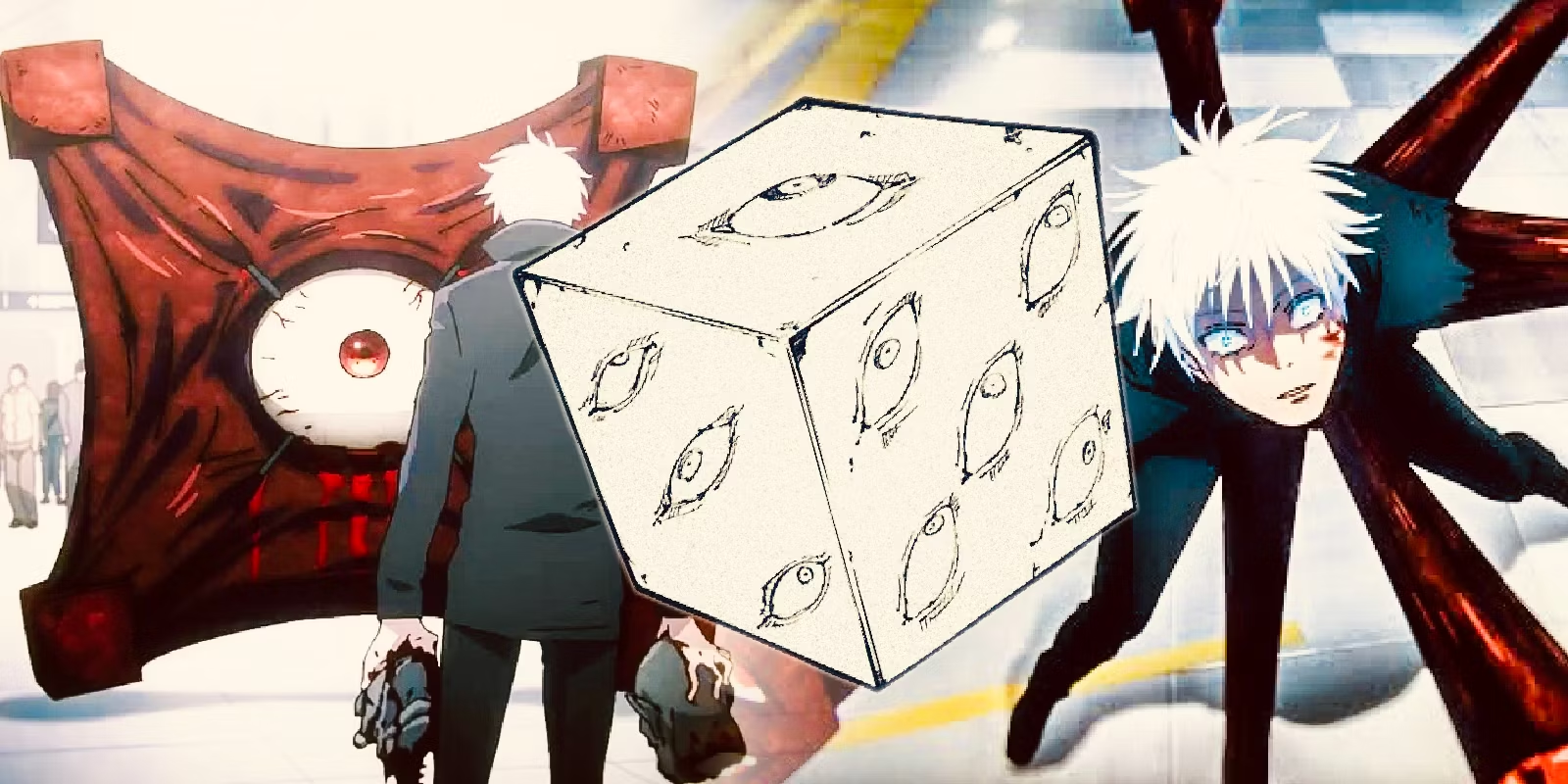
The Shibuya Incident is the Arc where the shit hits the fan. We don’t get to see much of Gojo is this arc, as he shows that by now, he’s not just got talent he’s got finesse. He knows how to use his overwhelming power to maximize efficiency and minimize casualties. This just reinforces what we already know. However in this Arc Gojo gets caught by his trauma. After pushing himself to the point of exhaustion to 3v1 Cursed Spirits so powerful they’re known as “The Disaster Curses” (Each worth a little less than half of a full power Sukuna), “Geto” shows up and confronts Gojo distracting him just long enough by revealing that he’s actually another Ancient Curse that’s just taken over Geto’s corpse, to seal Gojo in a cursed object called the prison realm, where he remains until the Culling Games Arc is closing up.
The Sukuna Cycle
MANGA ONLY – MAJOR SPOILERS
We get to see a lot more of Gojo’s character here, as the character he saved from execution all the way back in JJK Zero, Yuta Okkotsu, mentions that Gojo is always expected to be the monster so no one else has to be.
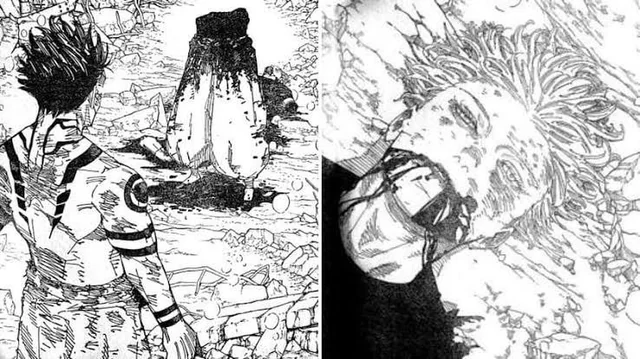
Gojo dies in this arc going all out against a full power Sukuna. What’s more, he doesn’t even get the respect of dying on screen. The killing blow was made while the perspective cut away to somewhere else. He even gave Yuta permission to take over his corpse the same way the his best friend Geto was taken over.
As much as Gojo fans wanted it to be so, Gojo is not the main character of this story, but he is a compelling one.
Conclusion
So what makes this guy different from other Shonen mentors like Kakashi and All-Might.
First off, he has a satisfying character arc. He dies for his beliefs protecting the next generation he believed in so much, meanwhile Kakashi and All-Might are left as a hanging threads, with no real ability to influence the plot despite still being present within it. I wish more writers had, dare I say, the balls to pull off a move like this. Everyone expects feel-good moments from Shonen, but when characters die it has weight and it means something, but many of these writers are too afraid of fan backlash to let characters have a death that really has an impact on the narrative.
Second off, he remains relevant throughout the entirety of his tenure, the narrative creates barriers, both literal and metaphorical, to keep him in check rather than relegated to a sideline position by the end of his narratives. Even his death is relevant, to finally establish Sukuna as the final boss threat that he really is, instead of leaving him as an empty threat. Kakashi is a legend sure, but he’s entirely forgotten about at the end of the narrative he’s apart of, and All-Might is only a symbol of the past in his. Gojo in his narrative is a symbol of a possible future where everyone is treated more fairly, and his death doesn’t symbolize the extinguishment of that ideal, it just shows a passing of the torch to the new generation.
Finally Gojo means something to the world he’s apart of. He’s such a big player that the main villains always have to plan around his existence. He’s such a boss that the small fry of the world he’s apart of fall in line. He’s such a big deal that even the Cursed Spirits, the fodder enemies, are described as being universally stronger simply because he exists. Not only that but he means a lot to people outside the narrative he’s part of too. So much so that when he was killed in the manga, people in Japan made a little shrine dedicated to him. We don’t see anything like that for Kakashi or All-Might.